7 History 'Facts' Almost Everyone Gets Wrong
Napoleon wasn't tiny, Vikings didn't wear horned helmets, and medieval people knew the Earth was round. Seven popular history myths, what really happened, and how each myth got started.
By Alexander Rahman · · 5 min read
Some "facts" are so familiar we never stop to check them. We learned them at school, or from a film, or from a quiz night, and they just sat there in our heads, quietly being wrong.
History is full of these. Here are some of the most common — what people believe, what actually happened, and, where we can work it out, how the myth got started. I find the "how it started" bit is often more interesting than the myth itself.
1. Napoleon was very short
The image of Napoleon as a tiny, angry man is everywhere. It's even given its name to a supposed "Napoleon complex."
In fact he was roughly average height for a Frenchman of his time — usually given as about 1.69 meters, or around five foot seven. The confusion seems to come partly from units: French inches (pouces) were longer than English inches, so his recorded height of "five foot two" in French measures sounded tiny to English ears. British caricaturists, who were not exactly neutral about him, happily drew him as a furious little man. And he was often seen surrounded by his Imperial Guard, who were selected partly for being tall.
So: average height, unlucky with units, and on the wrong side of some very effective cartoonists.
2. Vikings wore horned helmets
Probably the most famous costume mistake in history. No Viking helmet with horns has ever been found from the Viking Age. The one reasonably complete Viking-era helmet we have — found at Gjermundbu in Norway — is a plain rounded iron cap.
Horns would have been impractical in a fight, too. Something for your enemy to grab.
The horned look largely comes from the nineteenth century, when Scandinavian and German romantic art loved dramatic, wild northern warriors. It got a big boost from the costumes designed by Carl Emil Doepler for the first full production of Wagner's opera cycle The Ring of the Nibelung at Bayreuth in 1876. Opera, it turns out, has a lot to answer for.
3. People in the Middle Ages thought the Earth was flat
They didn't — at least, educated people didn't. The idea that the Earth is a sphere goes back to ancient Greece, and medieval scholars knew it perfectly well. A thirteenth-century textbook still used for centuries afterwards was literally titled On the Sphere (De sphaera, by Johannes de Sacrobosco). Medieval kings were often depicted holding an orb — a sphere — as a symbol of the world.
So where did the myth come from? Largely from the nineteenth century, when some writers liked to paint the Middle Ages as an age of ignorance, especially in contrast to their own supposedly enlightened times. Washington Irving's popular 1828 biography of Christopher Columbus helped spread the idea that Columbus had to argue with flat-Earth churchmen. He didn't. The real argument was about how big the Earth was — and, as it happens, Columbus's critics were closer to right than he was.
4. Marie Antoinette said "Let them eat cake"
There's no reliable evidence she ever said it. The line (in French, something like "Qu'ils mangent de la brioche") appears in the Confessions of the philosopher Jean-Jacques Rousseau, where he attributes it to "a great princess." Rousseau wrote that section of his book around the mid-1760s — when Marie Antoinette was a young child in Austria, years before she came to France.
The phrase was a sort of stock story about out-of-touch royalty, and it attached itself to her later, because she was a convenient target. She was certainly no saint, but this particular line almost certainly wasn't hers.
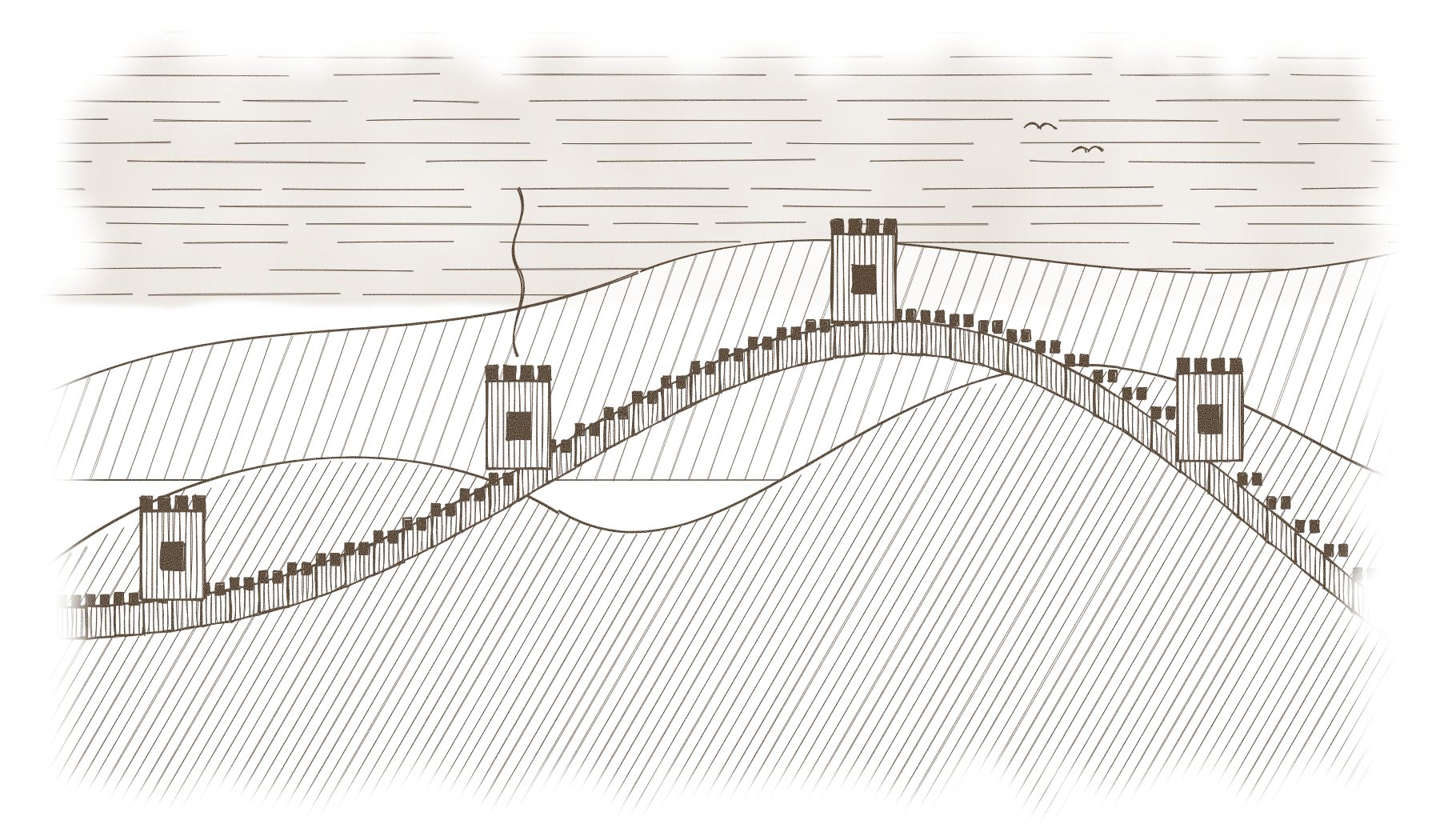
5. You can see the Great Wall of China from space
I've written about this one before, because it bothers me. You can't see the Great Wall from the Moon, and from low Earth orbit it's extremely hard to make out with the naked eye — it's very long, but narrow, and often the same color as the land around it. China's first astronaut, Yang Liwei, said in 2003 that he hadn't been able to see it.
The myth is actually older than space travel. Versions of the claim appear in print well before anyone had been into orbit, which tells you it was never based on observation in the first place.
6. Slaves built the pyramids
This one's popular in films, and it isn't supported by the evidence. Archaeologists excavating at Giza found a workers' town with bakeries, breweries and evidence the workers ate a lot of meat, plus workers' cemeteries close to the pyramids — burials with honor, and skeletons showing healed injuries, which suggests medical care. Many Egyptologists now think the pyramids were built by skilled permanent workers plus rotating teams of labourers, fed and housed in return.
That's not the same as freedom in our sense. But it's a very long way from the whip-cracking image.
7. Medieval people never washed
Also not true. Bathing was common in many parts of medieval Europe, and towns often had public bathhouses — in some cities, lots of them. Washing hands and face daily was normal advice. Attitudes to bathing did change over time, and in some later periods certain doctors worried that bathing could open the body to disease. But "everyone in the Middle Ages was filthy all the time" is a modern exaggeration.
Why do myths like these stick?
A few patterns come up again and again:
- They make a good story. A tiny furious emperor is funnier than an average-height one.
- They flatter us. "People in the past were ignorant and dirty" makes us feel clever and clean.
- They come from art, not records. Operas, cartoons, paintings and films shape what we "know" far more than documents do.
- They're repeated without checking. Once a claim is in enough books, it starts to look like fact.
The fix isn't to distrust everything. It's to ask one simple question whenever you meet a surprising historical "fact": how do we know? Who first said it? When? Were they there?
You'll be amazed how often the trail goes cold.
If you enjoy separating history from legend, Echoes of History does exactly that for fourteen real unsolved mysteries — from a vanished Roman legion to the man on the beach in Adelaide.
- #history
- #myths
- #facts
- #education